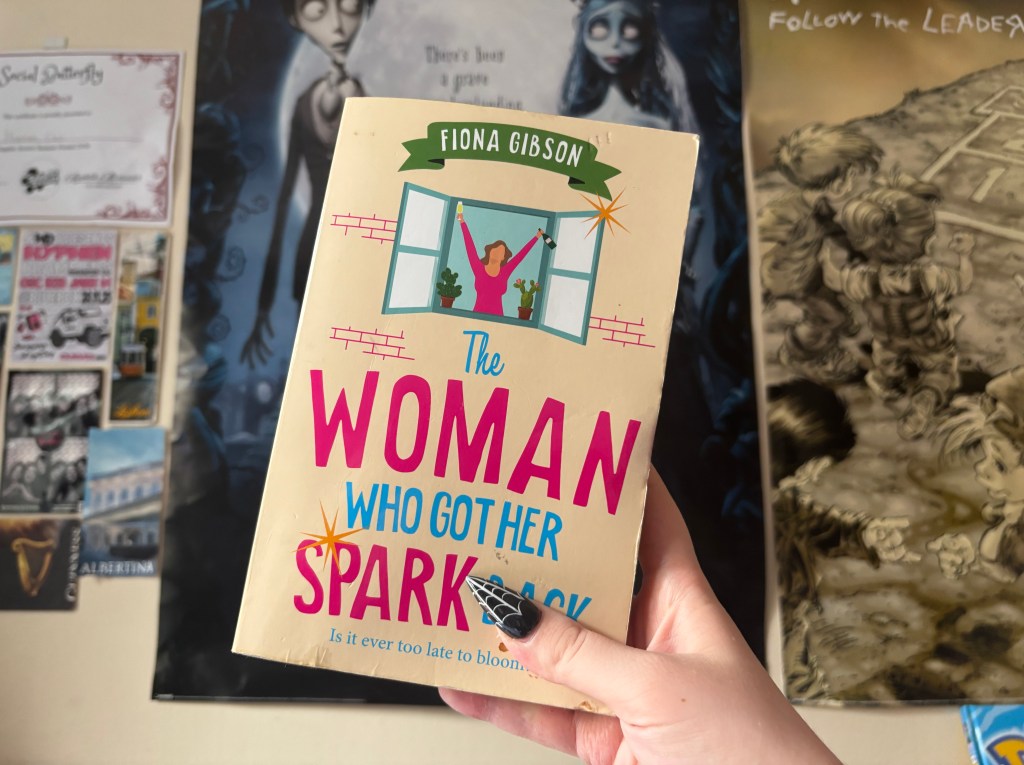
A review of Fiona Gibson’s The Woman Who Got Her Spark Back
Eyes on the shelves, scanning for my next read, I knew I was searching for something optimistic. The books already placed on my bookshelf promised struggle, sadness and no guarantee of a happy ending. To crush the hopelessness I was feeling, I needed to freshen up my TBR with something positive. The Woman Who Got Her Spark Back was gleaming back at me, the rather on the nose title leaving nothing to be questioned. I knew exactly what I was getting, the communication front and centre. The cover boasted a happy cartoon woman leaning out of an open window holding a bottle of bubbly. Perfect.
Once I started reading and became invested in Celia and Enzo’s concurrent stories, it got me thinking about how many avid readers and literature fanatics would judge this book for not being a behemoth opus, an intricate, complex and multifaceted work of fine art. Studying English Literature at a Russell Group university means I meet people like this often, unable to enjoy something unless its author has won the Nobel Prize for literature or been Poet Laureate. Why do we allow ourselves to get so immersed in a form of art that we become judgemental, perched upon a golden stallion and looking down upon anything that isn’t The Portrait of a Lady?
I enjoyed The Woman Who Got Her Spark Back so strongly because it appeared to me when I needed it the most. A hopeful story taking on real-life problems of setback, betrayal and connection, it reminded me of the ever-repeated cliche that things do improve, and meaningful relationships appear when you least expect them. From hardship, always comes the chance to grow, making space for better things, which is my interpretation of the novel’s main message.
Celia’s turbulent relationship with her concerning mother was the most moving and impactful of the story, ending unfinished but with lingering potential. An alcoholic, avoidant and borderline abuser, Celia’s mother was difficult to get behind, but Gibson’s thoughtful writing meant I couldn’t help but empathise, and wish I could’ve seen her journey to recovery. Addressing intense and emotional topics in an accessible way is something Gibson does remarkably: the reader doesn’t need to cut through dense symbolism to follow the prose. Getting people reading and making literature accessible is something I’m really passionate about, and even my mum, who hasn’t picked up a book since school, would enjoy the writing style and content of the novel.
The summer break from university is always a chance for me to get back into reading for pleasure, a hobby that gets neglected over the academic year. Uplifting and hopeful novels like these make it easier to reintroduce this into my life. So, if you made it this far, take a trip to a bookshop, trust your instinct and look with intention, picking out whatever speaks to you and giving it a chance. It might just be exactly what you needed to find.


Leave a Reply