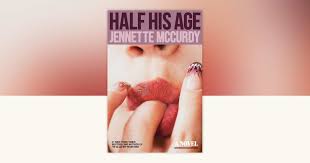
Welcome to Love is in the Pen, my new literature and book review series!
I grew up watching Jennette McCurdy almost every day and I fell in love with her Nickelodeon character, Sam Puckett, instantly. It was only upon the release of her incredible and raw 2022 memoir I’m Glad My Mom Died, that I learned just how broken the girl behind the confident character was. I’m Glad My Mom Died was an easy five-star for me. It was the realest, most honest celebrity memoir I’ve ever read, and didn’t shy behind any of the traumas faced by its writer. McCurdy had a crazy, turbulent and almost unbelievable childhood that the memoir could be read as a schedule of storylines for EastEnders.
Since then, McCurdy’s love for writing has blossomed, hence the birth of her first novel Half His Age (2026). I listened to McCurdy speak about the book on the Call Her Daddy podcast, and I was interested to find out how she had translated some of the themes from memoir to fiction. How would the experiences of her protagonist, Waldo, echo the writer’s past navigating a relationship with an older man when she was eighteen, coming from a Mormon background? How would the behaviour of Waldo’s mother reflect that of McCurdy’s own, leaving space for her to examine unhealthy family dynamics in a different way?
Half His Age spotlights a confident, self-aware and introspective seventeen year old named Waldo, who becomes fixated on her creative writing teacher, Mr Korgy. It explores Waldo’s loneliness through her unstable mother, childhood ‘best friend’ who she doesn’t really like, and her online shopping addiction which distracts her from the absences around her. Firstly I was drawn to the name choice. A modern seventeen year old girl named Waldo? Maybe I’m just not aware of the popularity of names in Alaska. The name Waldo is derived from the Germanic element wald, which means rule or power, and it began making more sense to me why the protagonist of a novel consumed by power and desire would be named Waldo. For me, names have reputations and connotations, so the artistic choice of such a unique name felt powerful to me because I didn’t have any assumptions about who our Waldo was going to be.
Waldo’s self-awareness was an area I thought McCurdy really got right. She knows when she’s celebrating the bare minimum and when she isn’t being given enough. She doesn’t defend Korgy, but admits she is powerless, admits she is willing to accept not enough just to have him. She knows it’s bad to view relationships this way, but seeing relationships through the role model of her unstable mother means she isn’t equipped with the tools to change hers. Not to mention the power dynamic, which becomes complex when the system shifts and Waldo gains an element of control, Korgy being the whimpering yearner with a broken life.
An observation I did have was that some of the references felt like McCurdy was trying too hard to appeal to Gen Z. The mentions of a Glossier fig lip balm, overuse of TikTok, a passing comment about SHEIN’s ethical concerns and having an online shopping addiction felt unnatural, and didn’t land with the relatable, comic tone I think McCurdy intended. The huge social issue of women’s reliance on consumerism is frequently mentioned and glossed over based on Waldo’s job at Victoria’s Secret, but I’m not entirely sure how relevant these frequent but small references are to the story’s main themes. Waldo does, in some instances, come across as the ‘I’m not like the other girls’ type, I think because the author opts for a stark, matter-of-fact monologue tone. With seldom fluffy language and straight-forward but sharp emotion, the narration creates a character who is unlikeable, but for whom I do have deep empathy.
Most one and two star reviews I’ve read of the novel mention the sex scenes as a point of issue, namely their frequency, uncomfortability and graphic nature. These scenes were actually a highlight for me, their age-based uncomfortability an important aspect. Waldo is seventeen and yet already has a difficult and saddening relationship with sex and intimacy. When the scenes involve boys her age, generally, she’s doing it out of impulsivity and nothingness. Not a genuine sexual or emotional connection. Not like with Korgy. And that’s the saddening aspect: the most intimate, intense and out-of-body sexual encounters she has are with her older teacher. Encounters that are scarred by infidelity, power imbalances and emotional dysregulation, rendering any positive aspect irrelevant, which is sometimes hard to see since Korgy is such a complicated, broken villain.
Crucially, there is a scene where Waldo performs a sexual act on Korgy without his consent, in fact, he repeatedly declines. She uses his body’s natural responses as a message of consent. This scene is moved away from swiftly, without contemplation, without Waldo’s introspective questioning of it or analysing the encounter, which surprised me because throughout the novel I was impressed by Waldo’s self-awareness.
I gave this novel four stars because I did massively enjoy it. I was entertained and made uncomfortable, interested in the power dynamics and horrified by them. The writing was direct and engaging, I did actually struggle to put it down!
 Diary of a Happy Goth
Leave a comment